Key points
- According to COLOSS, 16.7% (2018-2019) then 18.1% (2019-2020) of colonies were lost over winter, with wide differences between countries.
- Most winter losses are decided in August and September, when winter bees are reared.
- Varroa and viruses, starvation, queen failure and colonies that are too weak are the main causes.
- A dead hive can be "read": cluster position, stores, heads in cells, varroa traces.
- Close a dead hive quickly to prevent robbing and disease spread.
Losing colonies over winter is part of beekeeping. But high losses almost always have an identifiable cause, usually set in motion well before the first frosts. A large European study showed that disease control, especially of varroa, and beekeeper training strongly influence colony survival1.
This page explains how a colony gets through winter, why it may die, how to “read” a dead hive and how to prepare colonies for winter.
How many colonies die over winter?
The international COLOSS network runs a standardised survey of beekeepers every year. For winter 2018-2019 it covered 35 countries, nearly 28,600 beekeepers and over 738,000 colonies: the overall loss rate was 16.7%, ranging from 5.8% to 32% between countries. These losses broke down into dead colonies (10.7%), unsolvable queen problems (4.1%) and natural disasters (1.9%)3. For winter 2019-2020, across 37 countries, the overall rate was 18.1%, ranging from 7.4% to 36.5% between countries2.
These averages hide large differences between operations. In the European EPILOBEE study (17 countries, nearly 5,800 apiaries, 2012-2014), small apiaries run by inexperienced hobbyists lost about twice as many colonies over winter as professional operations (14% against 8%)1. Training, keeping an apiary record and coordinated varroa treatment were associated with better survival. The COLOSS surveys also find fewer losses in large operations and among beekeepers who winter a high share of young queens3.
How a colony gets through winter
Winter bees
In the active season a worker usually lives a few weeks. Bees born from late summer onwards are different: these are winter bees, able to live for several months and carry the colony through to spring6. Their longevity rests on a well-developed fat body and high levels of vitellogenin, a storage protein that also plays a role in protection against oxidative stress and in immunity. As long as these bees do not rear brood or forage, their vitellogenin stays high and they age slowly7.

The practical consequence: wintering success is decided when these bees are reared, in August and September in temperate climates. A Dutch study showed that winter bees from colonies not treated against varroa lived markedly shorter lives, and that colonies treated as early as July had the best individual survival and the largest spring population5.
The winter cluster
When the outside temperature drops, the bees gather in a cluster on the combs around the queen. Bees in the core produce heat by vibrating their flight muscles without moving their wings; those in the tightly packed outer layer form an insulating shell. Measurements show that the core stays much warmer than the shell and that heat production is highest at the centre and falls towards the surface: the cluster’s thermal stability depends both on the insulation of the outer layer and on the work of the bees in the centre8. When the colony resumes brood rearing in late winter, the brood area is kept much warmer, which increases the consumption of stores.
The cluster moves slowly, eating the honey it is in contact with. In prolonged hard frost it cannot reach another comb and may starve a few centimetres from its stores.
The main causes of losses
Varroa and viruses
This is the leading cause of winter mortality in Europe. In the German colony monitoring project, colonies that died over winter carried around 15 mites per 100 bees in October, against around 3 for survivors. Deformed wing virus and acute bee paralysis virus in autumn were also associated with losses4. Parasitised winter bees live shorter lives and the colony dwindles, often with stores intact. See Varroa and Deformed wing virus.
Starvation
Insufficient stores, badly placed honey, early resumption of laying or a cluster trapped by cold: starvation often strikes in late winter, when brood rearing resumes.
The queen
An ageing queen, a poorly mated one or one that dies during winter: the colony cannot renew its bees in spring. In the German monitoring, colonies headed by young queens survived better4; the COLOSS surveys point the same way3.
Colonies that are too weak
A small cluster loses more heat relative to its volume and covers less of the stores. In the German monitoring, colonies that died occupied markedly fewer seams of bees in October than survivors4.
Nosema and dysentery
The role of nosema in winter losses is debated: the German monitoring found no significant effect of Nosema4. Heavy faecal staining can also come from non-infectious dysentery (unsuitable food, a long period without cleansing flights).
Damp, rodents and poisoning
Condensation chills the cluster and encourages mould. A mouse destroys combs and disturbs the colony (see Mice and rodents). Late-season poisoning can weaken winter bees. Often these factors add up.
Reading a dead hive
Look before touching: cluster position and size, location of stores, brood, combs and floor.
| What you see | Probable cause |
|---|---|
| Small cluster, often with the queen, plenty of stores, hive almost empty of bees | Varroa and viruses: autumn or early-winter dwindling |
| White varroa droppings on the upper walls of brood cells, bees with deformed wings | Varroa and viruses |
| Tight cluster, many bees head-first in cells, no stores in contact | Starvation |
| Dead cluster on empty combs, honey a few frames away | Isolation starvation during prolonged cold |
| No brood, or drone brood in worker cells, several eggs per cell | Queen problem (drone-laying queen, laying workers) |
| Combs and hive front heavily stained with faeces | Dysentery or nosema (laboratory analysis needed to tell) |
| Very small cluster and few frames covered from autumn | Colony too weak going into winter |
| Mouldy combs, water on the floor, damp dead bees | Damp, insufficient ventilation |
| Gnawed combs, nest material, droppings on the floor | Mice |
| Ropy dead brood, stuck-down scales, abnormal smell | Suspected foulbrood: move nothing, have it tested |
| Empty hive, no bodies and no stores, shredded combs | Robbing after weakening, or absconding |
A layer of dead bees on the floor is normal at the end of winter: what matters is the bees and stores that remain.
What to do straight away
- Close the entrance to prevent robbing, which would spread mites and diseases.
- Check any remaining brood. Brood suspected of American foulbrood must be reported to the veterinary services; nothing leaves the hive until the result is known.
- Remove the hive and only reuse the combs after checking them; soiled or old combs are rendered down and the equipment disinfected (see Disinfecting equipment).
Regulations
In France, an ordinary winter loss is not a notifiable disease. However, suspected American foulbrood must be reported to the veterinary services, and abnormal or massive mortality may be reported. The Observatory of honey bee mortality and weakening (OMAA), being rolled out region by region, collects reports of mortality, depopulation and weakening through a telephone helpdesk, even when the cause is unknown10. Rules differ between countries: check with your local veterinary authorities.
Preparing for winter
Treat varroa early
This is the most effective measure: main treatment straight after the last harvest, a follow-up mite count, then a broodless treatment in early winter5, 6. The FAO stresses regular monitoring and coordinated treatments9.
Secure the stores
Needs vary with climate, bee strain and the length of winter: no universal figure applies. Stores should be capped, in contact with the brood nest and above the future cluster. Syrup is given early enough to be capped before the cold; later on, only fondant is suitable.
From the field. An example from a temperate climate: winter feeding is done case by case, colony by colony: up to three syrup feeds in September-October, checking stores until mid-October. Syrup stops when the clocks go back; after that, only fondant if needed, until the clocks go forward. Hefting the hive is not enough and can even mislead: look at the combs. And an early-summer dearth usually hits the finest colonies.
Unite weak colonies
A colony that is too small or queenless in autumn has little chance of surviving winter: it is better to unite it with a healthy colony, for example using the newspaper method. The EPILOBEE study actually linked uniting and buying swarms to higher losses, probably because they are used to make up for colonies already in difficulty1.
Site, ventilation and protection
- Site: sheltered from prevailing winds, away from damp hollows, hives raised off the ground.
- Ventilation: enough airflow removes moisture; an insulated roof limits condensation above the cluster; a slight forward tilt lets water run out.
- Mice: entrance reducer or mouse guard fitted before the first frosts.
- Hornets: autumn predation by the Asian hornet weakens colonies just when winter bees are being reared.
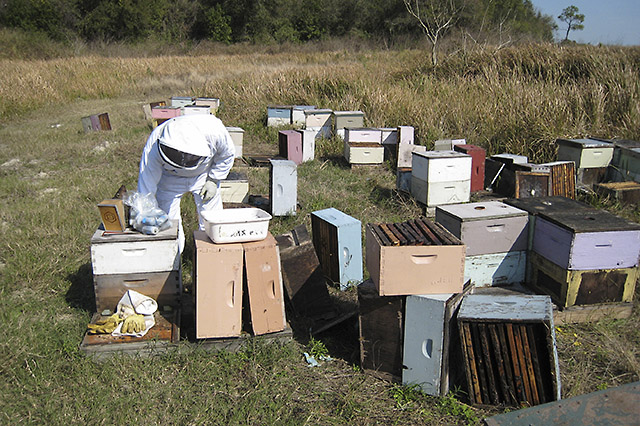
Monitoring colonies without opening them
In winter, hives are not opened: each opening chills and breaks up the cluster.
- Weighing. Hefting or weighing gives a consumption trend, to be read with caution: the weight includes wax and pollen, and does not say where the stores are in relation to the cluster.
- The entrance. In mild weather, cleansing flights signal a live colony. Crawling bees, deformed wings or heavy faecal staining on the front are warning signs, as is a silent entrance while neighbouring hives are flying.
- Inspection boards. Under a mesh floor, the board shows the position and width of the cluster (strips of cappings debris), mite drop after a winter treatment, and sometimes signs of mice.
Coming out of winter
On the first warm enough day, a quick inspection checks the brood, stores and colony strength. Light colonies are fed, queenless or drone-laying ones united, and dead hives closed and examined. The apiary review is used to correct the following autumn’s preparation.
In practice: what beekeepers actually do
Biology explains why colonies die over winter. Here is how beekeepers actually prepare colonies for winter, monitor them and react in spring.
The autumn checklist
- End of the last honey flow: supers off, varroa treatment for the whole apiary straight away.
- A few weeks later: follow-up mite count on representative colonies.
- Late summer: full inspection of each colony: queen present, healthy brood, number of frames covered with bees, stores.
- September: feeding colonies that need it, uniting weak or queenless colonies.
- Before the cold: entrance reducers or mouse guards, roofs checked, hives secured and tilted slightly forward.
- Early winter, broodless: additional varroa treatment according to the chosen strategy.
How to judge stores
Most beekeepers open the hive in late summer and look at the combs rather than hefting. It is common to estimate the capped honey frame by frame, checking above all what lies above and beside the brood nest, where the cluster will spend the winter. Weighing is then used to follow the trend.
When to unite
Usually at the end of summer or very early autumn, while bees are still flying. Beekeepers unite a colony that is too weak, queenless, drone-laying or headed by a poorly laying queen, keeping the best queen, and never a diseased colony.
During winter
- A visit to the apiary after every storm: roofs, toppled hives, entrances blocked by dead bees, cleared without opening.
- Comparative hefting to spot light colonies, which are given fondant placed directly above the cluster.
Faced with a dead hive in spring
- Close the entrance the same day.
- Open, observe, photograph, then compare with the reading table and record the probable cause.
- If brood looks suspicious, have it tested before moving anything.
- Starvation or queen problem, healthy combs: reuse possible after checking. Varroa or disease: strict sorting, old combs rendered down, disinfection.
- Several colonies dead with the same signs: talk to your animal health organisation.
Equipment to have
Entrance reducers or mouse guards, fondant in reserve, boards for mesh floors, a hive scale or spring balance, and the apiary record book.
The most common mistakes
- Treating varroa too late, in September or October: the winter bees are already parasitised.
- Wintering colonies that are too weak instead of uniting them.
- Relying on hive weight alone without looking at where the stores are.
- Feeding syrup too late, when bees can no longer cap it.
- Leaving a dead hive open or reusing its combs without looking for the cause.
- Keeping old queens without replacing them.
Frequently asked questions
What winter loss rate is “normal”? There is no official threshold. The COLOSS surveys recorded 16.7% then 18.1% losses for winters 2018-2019 and 2019-2020, with very large differences between countries and between operations2, 3. Losses markedly higher than in neighbouring apiaries call for a search for the cause.
My hive died with plenty of honey: why? This is the typical varroa-and-virus picture: winter bees parasitised during development die too early and the colony empties. More rarely, a cluster trapped by cold dies next to its stores.
Why do colonies die in March, after the worst of the cold? The resumption of laying sharply increases the consumption of stores and the workload of the old winter bees. A colony already short of stores or bees may then collapse from starvation or exhaustion.
References
- Jacques A., Laurent M., EPILOBEE Consortium, Ribière-Chabert M., Saussac M., Bougeard S., Budge G.E., Hendrikx P., Chauzat M.-P. (2017). A pan-European epidemiological study reveals honey bee colony survival depends on beekeeper education and disease control. PLoS ONE 12(3): e0172591. doi.org
- Gray A. et al. (2023). Honey bee colony loss rates in 37 countries using the COLOSS survey for winter 2019–2020: the combined effects of operation size, migration and queen replacement. Journal of Apicultural Research 62(2): 204-210. doi.org
- Gray A. et al. (2020). Honey bee colony winter loss rates for 35 countries participating in the COLOSS survey for winter 2018–2019, and the effects of a new queen on the risk of colony winter loss. Journal of Apicultural Research 59(5): 744-751. doi.org
- Genersch E. et al. (2010). The German bee monitoring project: a long term study to understand periodically high winter losses of honey bee colonies. Apidologie 41(3): 332-352. doi.org
- van Dooremalen C., Gerritsen L., Cornelissen B., van der Steen J.J.M., van Langevelde F., Blacquière T. (2012). Winter survival of individual honey bees and honey bee colonies depends on level of Varroa destructor infestation. PLoS ONE 7(4): e36285. doi.org
- Döke M.A., Frazier M., Grozinger C.M. (2015). Overwintering honey bees: biology and management. Current Opinion in Insect Science 10: 185-193. doi.org
- Amdam G.V., Omholt S.W. (2002). The regulatory anatomy of honeybee lifespan. Journal of Theoretical Biology 216: 209-228. doi.org
- Stabentheiner A. et al. (2003). Endothermic heat production in honeybee winter clusters. Journal of Experimental Biology 206: 353-358. doi.org
- FAO, IZSLT, Apimondia, CAAS (2021). Good beekeeping practices for sustainable apiculture. FAO Animal Production and Health Guidelines No. 25.
- Faure B., FRGTV PACA (2024). L'Observatoire des mortalités et des affaiblissements de l'abeille mellifère (OMAA), un système de surveillance innovant. DRAAF PACA (in French). draaf.paca.agriculture.gouv.fr
- USGS Bee Inventory and Monitoring Lab. Apis mellifera, light body, side, Beltsville, MD (public domain). usgs.gov
- USDA ARS (2020). Helping honey bees make it through winter with early cold storage. Photo D4399-1, Jeff Pettis (ARS image gallery, public domain). ars.usda.gov